Format — 05
Hackathons.
Build something in one evening. Cross-disciplinary teams, a real problem from a domain partner, working prototypes by the end of the night.
For
Community & B2B
Where
Copenhagen, or your office
Duration
4–8 hours · in-person
Upcoming.
The next hackathon and what it’s about. Click through for the full brief and registration.
No hackathons scheduled right now. Get in touch if you'd like to host the next one.
Past.
Hackathons we've run: briefs, photos, and what teams built.
Tue 26 May 2026 · 16:00–20:00
Past
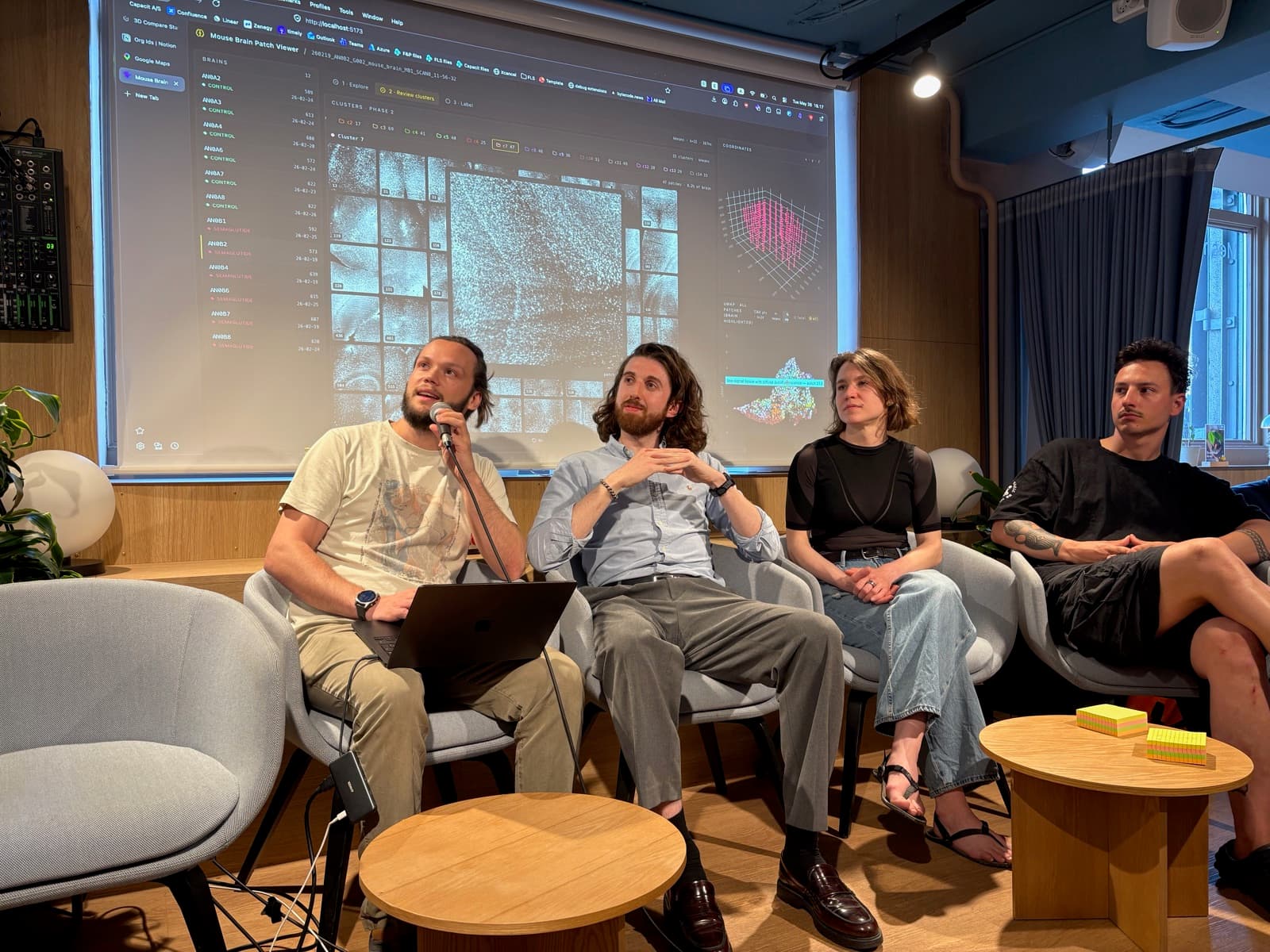
Explainable Brains.
A 4-hour sprint to make complex brain data accessible. Real imaging data from Vibraint, built with Claude Code, demos in front of the partners.
Mesh Matrikel1, Copenhagen
How a night runs.
A short brief, a tight build window, demos in front of the people whose problem it is. No theatre, no homework.
01 Brief
Real problem, real data.
A short, concrete challenge from a domain partner. No prizes-and-theatre, no fictional scenarios. The work is useful by definition.
02 Build
Teams form on the spot.
Cross-disciplinary by design. Claude Code, free Anthropic credits, the partner's data, and a few hours to put something together.
03 Demo
Three minutes per team.
Working prototype, not pitch deck. Judges and domain partners in the room: the people whose problem it actually is.
04 Connect
The night doesn't end at demos.
Drinks, conversations, and the start of new collaborations across disciplines. The most durable outcomes come from this part.
Principle
Working prototype, not pitch deck.
What you take home.
Concrete outcomes, not certificates. Four things you take back to Monday.
01 A working prototype
Code that runs.
At the end of the night you have something to show, not a slide. Yours to keep, extend, and bring back to your team.
02 New collaborators
People you'd never meet otherwise.
A few hours building beside engineers, designers, PMs, scientists from completely different fields. This is where most of the long-term value lives.
03 Claude Code reps
Hands-on, under pressure.
The fastest way to learn the tool: a real problem, a tight deadline, someone next to you stuck on the same thing.
04 A real dataset
Not a tutorial dataset.
Domain experts in the room to explain what you're looking at, and the constraints that make the problem hard in practice.
Questions.
The short answers. Reach out if anything else.
- How do I register?
- Each upcoming hackathon has its own Luma page. Click the Upcoming card to see the full brief, or use the Register on Luma link to jump straight to sign-up.
- What does it cost?
- Community hackathons are free for participants, usually capped at 40 seats. B2B hackathons (hosted at your office, your problem, your data) are by quote.
- Do I need to code?
- Helpful, not required. Teams form on the night by background: engineers, designers, PMs, scientists end up at the same table. The partners in the room explain the domain.
- How are teams formed?
- On the spot. We help mix backgrounds so each team has a balance of perspectives. Come solo or with a friend; both work.
- What about food and drinks?
- Yes: vouchers, snacks, sometimes a hot dish mid-build. Specifics are on each event page.
Who it's for.
Builders curious about working across disciplines. STEM students, graduates, and young professionals, including product management and adjacent roles. No neuroscience background needed; teams are intentionally cross-functional, and the partners in the room explain the domain.
If you’d like to host or co-host a future hackathon (with your data, your problem, your domain), get in touch.